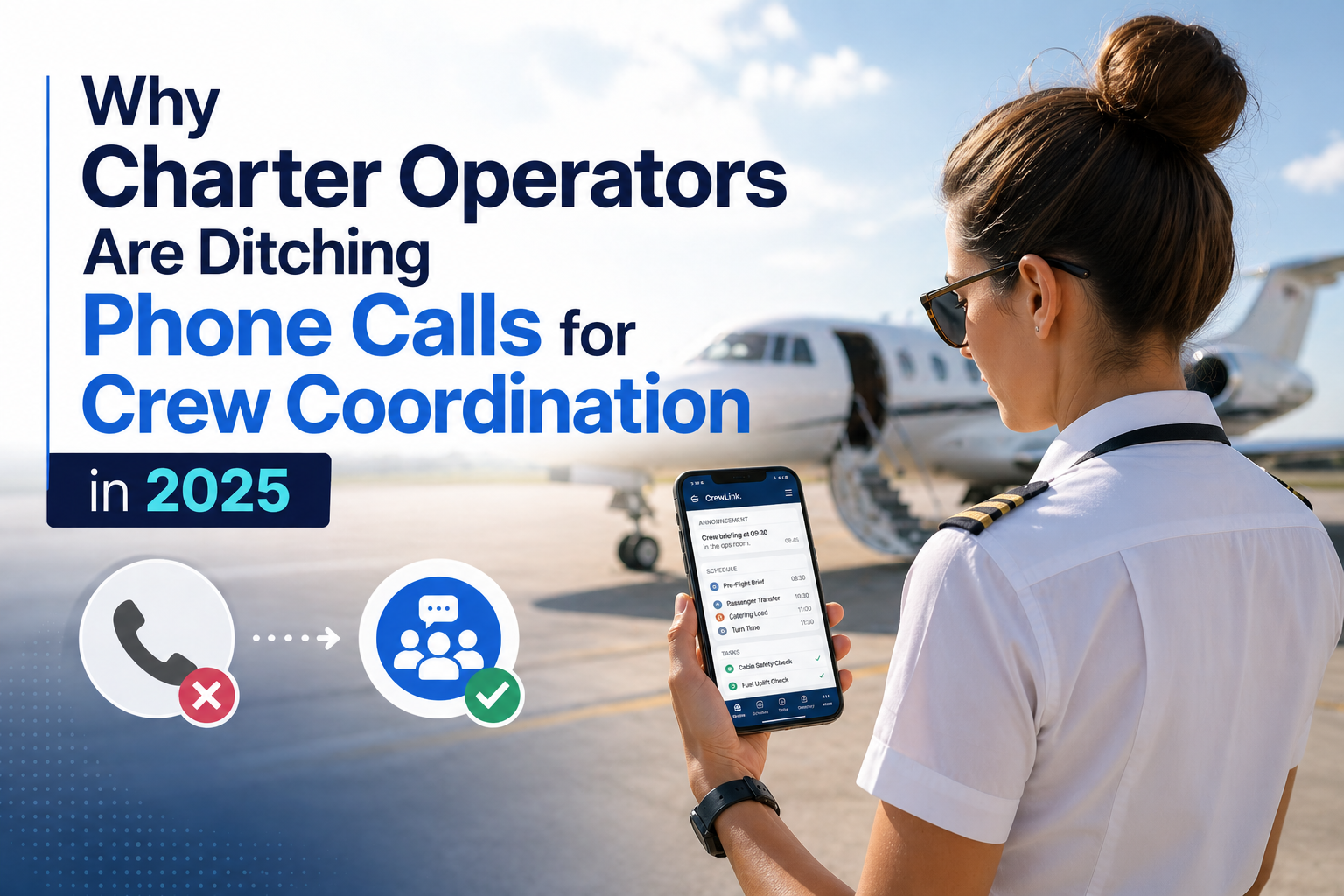
It's 6:47am. Your captain just called in sick. You have a flight at 10:00am and no replacement. What happens next determines whether you lose a client — or whether your operation has a system that handles it in minutes. Most charter operators still rely on phone calls. The fastest ones don't.
The private charter aviation industry is growing. Part 135 charter flights reached 417,314 departures in the first half of 2025 alone — a 4.2% increase year-over-year, and the trend shows no sign of slowing. More flights mean more trips to crew. More trips to crew mean more opportunities for the phone-tag problem to surface.
Yet despite the sophistication of modern aviation operations — GPS tracking, digital dispatch, automated weather briefings — most charter operators still coordinate replacement crew the same way they did in 1990: pick up the phone, call pilots one by one, leave voicemails, wait, follow up, repeat.
The Real Cost of Phone-Based Crew Coordination
When an ops manager needs to find a replacement captain at short notice, the typical process looks like this: open the contacts app, find pilot number one, call, wait for voicemail, leave a message, call number two, wait, get through, find out they're not current on the aircraft type, call number three... The average ops desk spends between 90 minutes and three hours resolving a single crew availability issue through manual phone calls.
2–3h Average time spent finding a replacement crew member by phone 417K Part 135 charter departures in H1 2025 — each one needs a confirmed crew 22,000+ Active business aircraft worldwide requiring crew coordinationThe time cost is obvious. But the hidden costs are worse:
- Client experience damage. When your ops desk is spending two hours chasing pilots, that energy isn't going to the client. Communication delays, nervous passengers, and last-minute uncertainty all trace back to a slow crew-finding process.
- First-mover disadvantage. Your best freelance pilots have multiple operator relationships. The operator who reaches them first gets them. If you're calling sequentially, your competitor who uses a broadcast notification system will confirm them before you reach them.
- Ops team burnout. Repetitive, anxiety-inducing phone calls are a significant contributor to staff stress and turnover in charter ops departments.
- Missed trips. In the worst cases, operators have cancelled flights because they couldn't find crew in time — not because crew wasn't available, but because the communication process was too slow.
Why SMS Changes Everything
The insight behind modern crew notification tools is simple: instead of calling pilots one by one, broadcast to all qualified pilots simultaneously and let them respond. The first available pilot who responds confirms. You go from a sequential process that takes hours to a parallel process that takes minutes.
SMS is the critical channel here. Email notification rates are unreliable — pilots may not check email immediately, especially early morning or late evening. Phone calls require the recipient to be free to answer. But SMS messages have a 98% open rate, with 90% read within three minutes of receipt.
"The moment I stopped calling pilots and started sending a message to all of them at once, my average crew confirmation time went from two hours to under fifteen minutes." — Charter Operator, European market
The magic link concept — where pilots receive a unique URL in their SMS or email and respond with a single tap, with no login or app download required — further removes friction. A pilot waking up at 6am gets a message, taps the link, sees the trip details, and confirms availability in under 10 seconds. The ops desk gets a live notification. Trip confirmed.
The Qualification Problem Nobody Talks About
One reason phone-based crew coordination is so slow isn't just the sequential nature of calls — it's that ops managers often don't remember which pilots are current on which aircraft at any given moment. They call someone, find out they're not rated on the specific aircraft, and start over.
Digital crew management platforms solve this by filtering the notification list before sending. When you post a trip requiring a Challenger 604-rated captain, only pilots with that rating on their profile receive the notification. Every response you get is from a qualified pilot. The qualification filter is applied automatically, eliminating one of the most common causes of wasted calls.
On-Call vs On-Roster: Both Operations Benefit
The phone-tag problem manifests differently depending on your operation type, but it affects both:
On-Call Operations
On-call operators maintain a bench of pilots they call when a trip comes in. The entire efficiency of their crew coordination depends on how fast they can match a qualified, available pilot to a trip. Broadcast SMS notification with one-tap response is the most direct solution to this problem.
On-Roster Operations
Roster operators have crew assigned to aircraft in advance. But when a trip is confirmed — especially last-minute — someone still needs to notify the assigned crew. If the notification goes through a captain who then calls the first officer and flight attendant, the communication chain is long and unreliable. Direct notification to all assigned crew simultaneously eliminates this chain.
What Modern Crew Coordination Looks Like
The operations departments that have moved away from phone calls describe a fundamentally different working environment. Instead of reactive, anxious scrambling when a crew issue arises, they work from a live dashboard: trip details are posted, pilots are notified, responses appear in real time, and the confirmation click closes the loop.
Tools like CrewBench are purpose-built for this workflow. Operators post a trip request, select qualified crew from their bench, and send SMS and email notifications simultaneously. Pilots respond via a magic link — one tap, no friction. The ops desk watches responses arrive on a live dashboard and confirms the crew with a single click.
Advanced features like seniority-based auto-notification take this further: the system works through the crew list automatically, notifying the highest-seniority available pilot first, advancing to the next if there's no response within a set time window, and stopping when someone confirms. No human intervention required.
5 minutes Average crew confirmation time using broadcast SMS notification vs 2–3 hours using sequential phone callsThe Technology Adoption Gap in Business Aviation
Business aviation has historically been slow to adopt operational technology. Many tools designed for airlines — sophisticated crew management systems, automated scheduling platforms — are too complex and expensive for the typical charter operator running a 2–5 aircraft fleet.
Digital channels now account for 38–42% of charter bookings in 2025, showing that the industry is embracing technology on the commercial side. But operational technology — specifically crew coordination — has lagged behind.
This gap represents an opportunity. The operators who modernise their crew coordination processes gain a competitive advantage through faster trip confirmation, better crew relationships, and lower ops department overhead. The ones who wait continue losing time to phone tag.
Getting Started Without Disrupting Your Existing Process
One concern operators raise when considering digital crew coordination tools is the change management overhead. Will pilots adopt the new system? Will the ops team resist changing their workflow?
The answer, with well-designed tools, is no — because the tools are designed to require no change on the pilot's side. Pilots don't download an app. They don't create an account. They receive an SMS, tap a link, and tap a button. The response is recorded automatically.
For the ops team, the workflow is additive: instead of opening their phone contacts, they open a trip dashboard. The learning curve is measured in minutes, not days.
The Bottom Line
The charter aviation industry is growing. Flight volumes are up, fleet sizes are expanding, and the demand for qualified crew is intense. According to Aviation Week, pilot demand remains high and compensation pressure is significant — which makes crew relationships more important than ever.
In this environment, the operators who can confirm crew fastest — who respond to a sale with a crewed and ready aircraft while competitors are still on their second phone call — will win the business.
Phone calls worked in 1990. In 2025, they're a competitive liability.
Stop Losing Time to Phone Tag
CrewBench lets you notify your entire crew bench in seconds and confirm a pilot in under five minutes. Start free — no credit card required.
Try CrewBench Free →