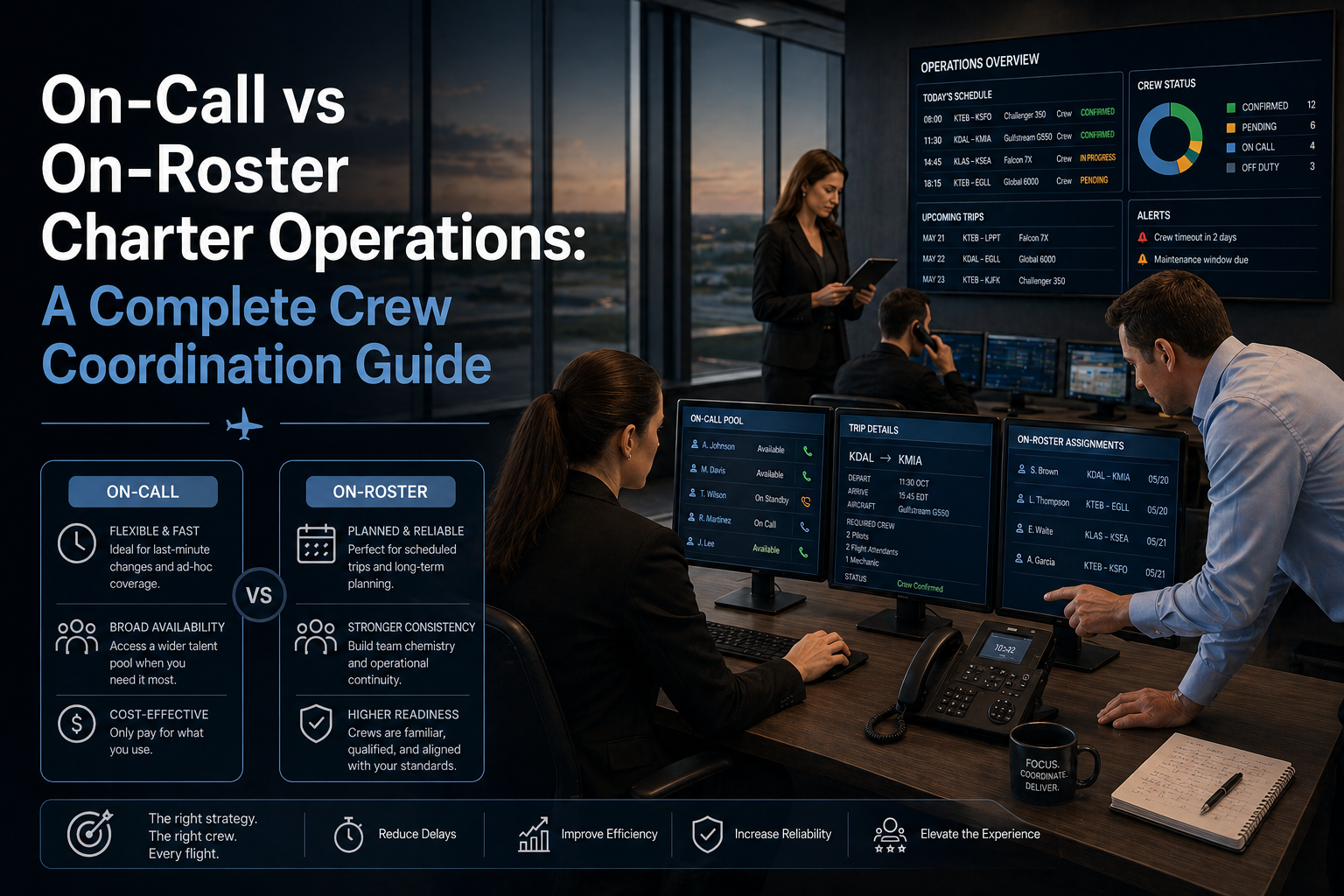
The biggest misconception in charter crew coordination is that there's one type of charter operation. There isn't. On-call and on-roster operations have fundamentally different crew challenges — and the best operators understand both, because most run elements of each simultaneously.
Understanding your operation type is the foundation of choosing the right crew coordination approach. The wrong tools for the wrong model waste time and money. The right ones make your operation faster, smoother, and more scalable.
Defining On-Call Charter Operations
An on-call operation sells flights on an ad-hoc basis. A client calls or books online. The operator accepts the trip. Then they find crew to fly it. The crew assignment happens after the sale, not before. This is the classic charter model: flexible, demand-responsive, and highly dependent on having a reliable pool of qualified crew available at short notice.
The primary crew challenge in on-call operations is speed of crew confirmation. From the moment a trip is accepted, the clock is running. The faster the ops desk can confirm a qualified crew, the sooner the client gets confirmation, the better the service experience.
On-Call Operations
- Trip sold first, crew found after
- Speed of crew confirmation is everything
- Relies on a bench of available, rated pilots
- Crew pool may include contract/freelance pilots
- Coordination challenge: finding qualified, available crew fast
- Tech solution: broadcast or seniority-based SMS notification
On-Roster Operations
- Crew assigned to aircraft in advance
- Trip communication is the challenge
- Crew waits for a sale to happen
- Typically employed or long-term contract crew
- Coordination challenge: notifying assigned crew instantly when trip confirmed
- Tech solution: automatic notification to assigned crew on trip creation
Defining On-Roster Charter Operations
An on-roster operation assigns crew to specific aircraft in advance. The crew is positioned — typically at the aircraft's base or nearby — and waits for a flight to be sold. When the sale is confirmed, the assigned crew are notified and begin their pre-flight preparation. The aircraft is essentially crewed and ready; the trigger is the sale, not the crew search.
This model is common among VIP operators, managed aircraft programs, and operators with large fleets who can justify positioning crew in advance. The primary crew challenge is not finding crew but communicating trip details to assigned crew instantly and reliably when a sale is confirmed.
In many on-roster operations, the communication chain is still phone-based: the sales department calls the captain, who then calls the first officer, who calls the flight attendant. This is a sequential chain with multiple failure points and unnecessary latency.
The Hybrid Reality: Most Operations Are Both
The clean distinction between on-call and on-roster breaks down quickly in practice. Most charter operators run a hybrid model:
- They have employed crew on specific aircraft (on-roster) but also maintain a bench of contract pilots for overflow (on-call)
- Their rostered crew occasionally hits duty time limits, requiring on-call replacement crew
- They have some aircraft with positioned crew and others where crew is found after sale
- Seasonal patterns shift them between models — busier seasons require more on-call bench depth
A crew coordination platform that handles both models from the same interface is genuinely more valuable than one optimised for only one. CrewBench detects which model applies to a given trip automatically: if the trip's aircraft has assigned crew, it offers a one-click "notify assigned crew" option. If not, it shows the full bench notification flow.
Crew Coordination for On-Call Operations: The Speed Imperative
In on-call operations, every minute between trip acceptance and crew confirmation is a minute of uncertainty for the client. Best-in-class on-call operators confirm crew within 15–30 minutes of accepting a trip. This requires:
- A well-maintained bench with current ratings and contact details
- A way to reach multiple pilots simultaneously (broadcast SMS)
- A zero-friction response mechanism for pilots (magic link, one tap)
- A live dashboard showing responses as they arrive
- A one-click confirmation mechanism
The phone-based approach fails at steps 2 and 3: it's sequential, not simultaneous, and it requires the pilot to answer a call rather than tap a link. Digital notification tools solve both.
Crew Coordination for On-Roster Operations: The Communication Imperative
On-roster operators don't have a crew-finding problem under normal circumstances — they have a communication problem. When a new trip is confirmed in their sales system, that information needs to reach the captain, first officer, and flight attendant simultaneously, reliably, and quickly.
The traditional captain-relays-to-FO-relays-to-FA chain introduces latency and failure points at each step. If the captain doesn't see the message immediately, the whole chain is delayed. If there's any ambiguity in what the captain communicates, it ripples through to the rest of the crew.
Direct notification from the ops system to all crew simultaneously — with the trip details embedded in the message, requiring a single confirmation tap — eliminates the chain entirely. This is what CrewBench's roster assignment feature enables: assign crew to aircraft, and when a trip is posted, all assigned crew receive simultaneous SMS and email with the full trip details.
Integrating Both Models in One Platform
The most elegant crew coordination solution for hybrid operators is a single platform that handles both models without requiring the ops team to choose a mode or switch interfaces. The system detects the situation and presents the right option:
- Aircraft has assigned crew covering the trip date → "Notify assigned crew" button appears
- Aircraft has no assigned crew → standard bench notification flow
- Aircraft has partial crew (e.g., captain assigned but no FO) → both options appear simultaneously
This design reflects the reality of charter operations: they're complex, fluid, and rarely fit neatly into a single model. The technology should adapt to the operation, not force the operation to adapt to the technology.
"We run both models depending on the client and the aircraft. The ability to handle crew notification the same way regardless of whether we're finding crew or just telling them about a trip has simplified our ops enormously." — Charter Operator, Middle East market
Planning for Growth: Which Model Scales Better?
On-call operations scale well with technology but require sustained investment in bench quality. As flight volume grows, the bench must grow proportionally — and the notification and response system must handle increasing volume without additional ops overhead.
On-roster operations scale with fleet size and the ability to manage a roster across multiple aircraft and bases efficiently. The coordination challenge shifts from "find a pilot" to managing crew schedules, qualifications, and assignments at scale.
Both models benefit from digital crew coordination, but the ROI manifests differently. On-call operators see the return in time saved finding crew. On-roster operators see it in communication speed and reliability when trips are confirmed.
Crew Coordination for Both Models
Whether you run on-call, on-roster, or both — CrewBench handles it from a single dashboard. Start free today.
Try CrewBench Free →