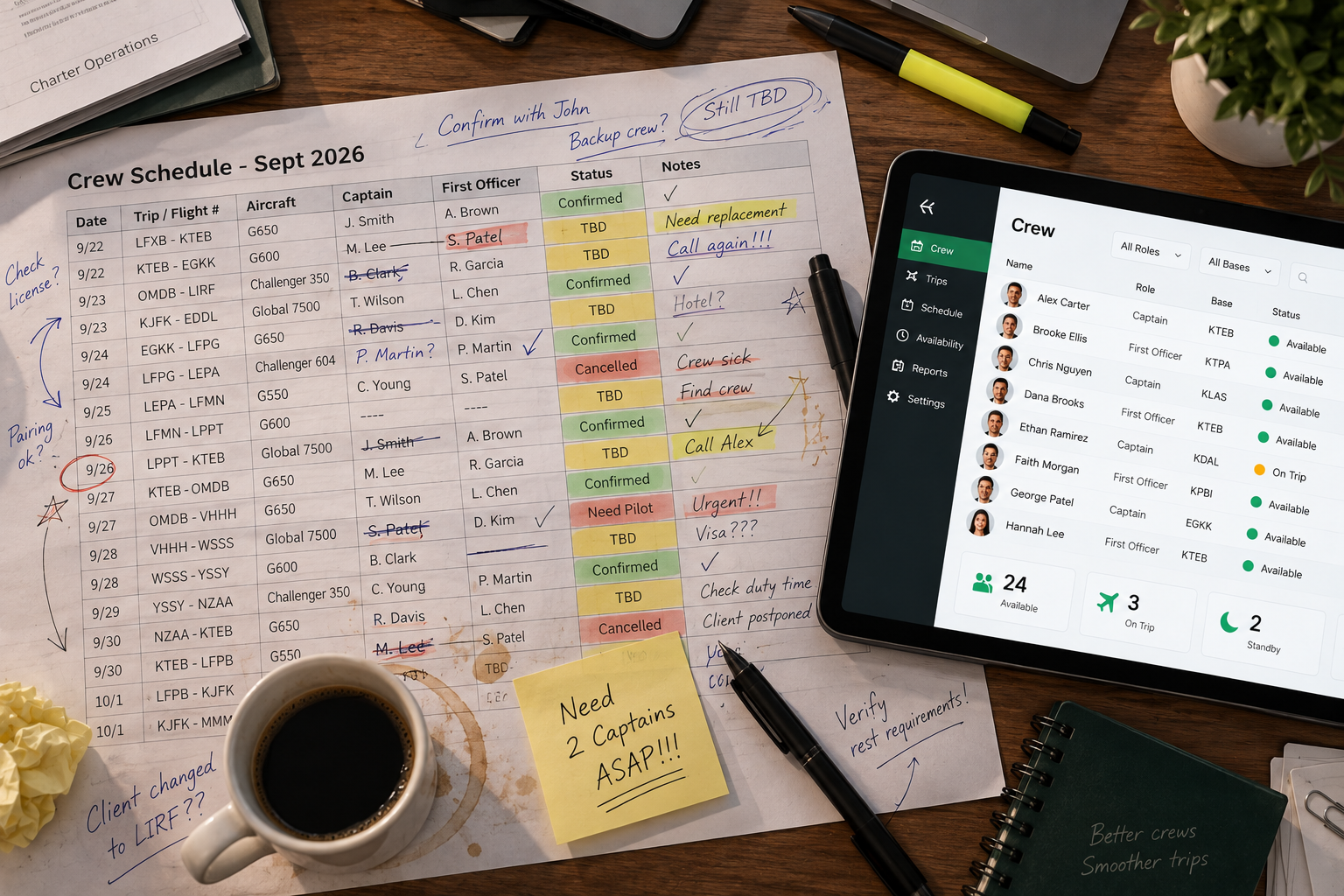
Every charter operator starts in the same place: a spreadsheet. Pilot names, phone numbers, type ratings, a column for notes. It works — until it doesn't.
This is an honest comparison of managing freelance pilots with a spreadsheet versus purpose-built software. Not a sales pitch. A framework for thinking about when the switch makes sense.
What spreadsheets do well
Let's be fair to the spreadsheet. It has genuine strengths:
- Zero learning curve. Everyone knows how to use a spreadsheet. No onboarding, no training, no new logins.
- Fully flexible. You can structure it however your operation works. Add columns, change formats, sort by anything.
- No cost. Google Sheets or Excel. Already paid for.
- Works for small benches. If you have 5 pilots, two aircraft, and a small trip volume, a spreadsheet is genuinely sufficient.
The problem isn't the spreadsheet. The problem is what it can't do — and what you end up building around it to compensate.
The hidden costs of spreadsheet-based pilot management
It doesn't notify anyone
A spreadsheet is a static record. When a trip opens, someone has to look at the spreadsheet, identify the right pilots, and then separately call or text each one. The spreadsheet and the notification process are two separate manual workflows stitched together by human effort every single time.
It has no real-time state
A spreadsheet shows you what was true when someone last updated it. It doesn't show you who responded to a notification five minutes ago, who's just gone unavailable, or who confirmed availability for a different trip. By the time you check it, it may already be wrong.
It creates no audit trail
Who did you call? When? What did they say? A spreadsheet records none of this. If a pilot disputes being passed over for a trip, or a regulator asks how the crew was selected, you have no documentation. "I called down the list" is not a defensible answer.
It breaks when your team changes
The institutional knowledge of how to use your spreadsheet — which cells matter, what the colour coding means, whose number is out of date — lives in the heads of the people who built it. When your ops manager leaves, that knowledge walks out with them.
It doesn't scale
One aircraft, five pilots, ten trips per month: fine. Three aircraft, twenty pilots, forty trips per month: the spreadsheet becomes a full-time job to maintain, and it still can't do the actual work of notifying crew and tracking responses.
What purpose-built software does instead
Task Spreadsheet Purpose-built software Notify pilots of a trip Manual — call or text each pilot separately One action — SMS + email to all qualified pilots simultaneously Track availability Manual update after each call Real-time dashboard updates as pilots respond Filter by type rating Manual — you have to remember or look up each pilot's ratings Automatic — only qualified pilots receive the notification Audit trail None — or manually reconstructed after the fact Automatic — every notification, response, and assignment is timestamped Seniority management Manual — high compliance risk Automated queue with configurable time windows Response analytics None Automatic — response times, availability rates per pilotWhen is the right time to switch?
There's no universal answer, but here are the clearest signals:
- You're spending more than 45 minutes per trip on crew coordination. That's the break-even point where software pays for itself in recovered time.
- You've had a compliance question you couldn't answer. If someone has ever asked "who did you notify and when?" and you couldn't give a precise answer, you have an audit trail problem.
- Your ops process depends on one person's memory. If a key team member leaves and your crew coordination process becomes unclear, the institutional knowledge is too fragile.
- You're running more than 2 aircraft or 15 trips per month. At this volume, the manual overhead of a spreadsheet is measurable and compounding.
- You've had a last-minute trip you couldn't fill fast enough. If you've ever had a close call with a last-minute crew gap, the cost of not having a faster system has become concrete.
The spreadsheet isn't the problem. The problem is everything you're doing manually around the spreadsheet that the spreadsheet can't do for you.
The transition is easier than you think
The most common reason operators stay on spreadsheets longer than they should is the assumption that switching requires a big project: data migration, staff training, a period of running two systems in parallel.
Purpose-built tools for charter crew management are typically operational within an hour. Import your pilot roster, add your aircraft, and the system is ready to send its first notification. There's no lengthy implementation — the tool is designed for exactly the workflow you already have, just without the manual steps.
Your spreadsheet was never the destination. It was the starting point. Most operators find the switch pays for itself in the first two weeks.