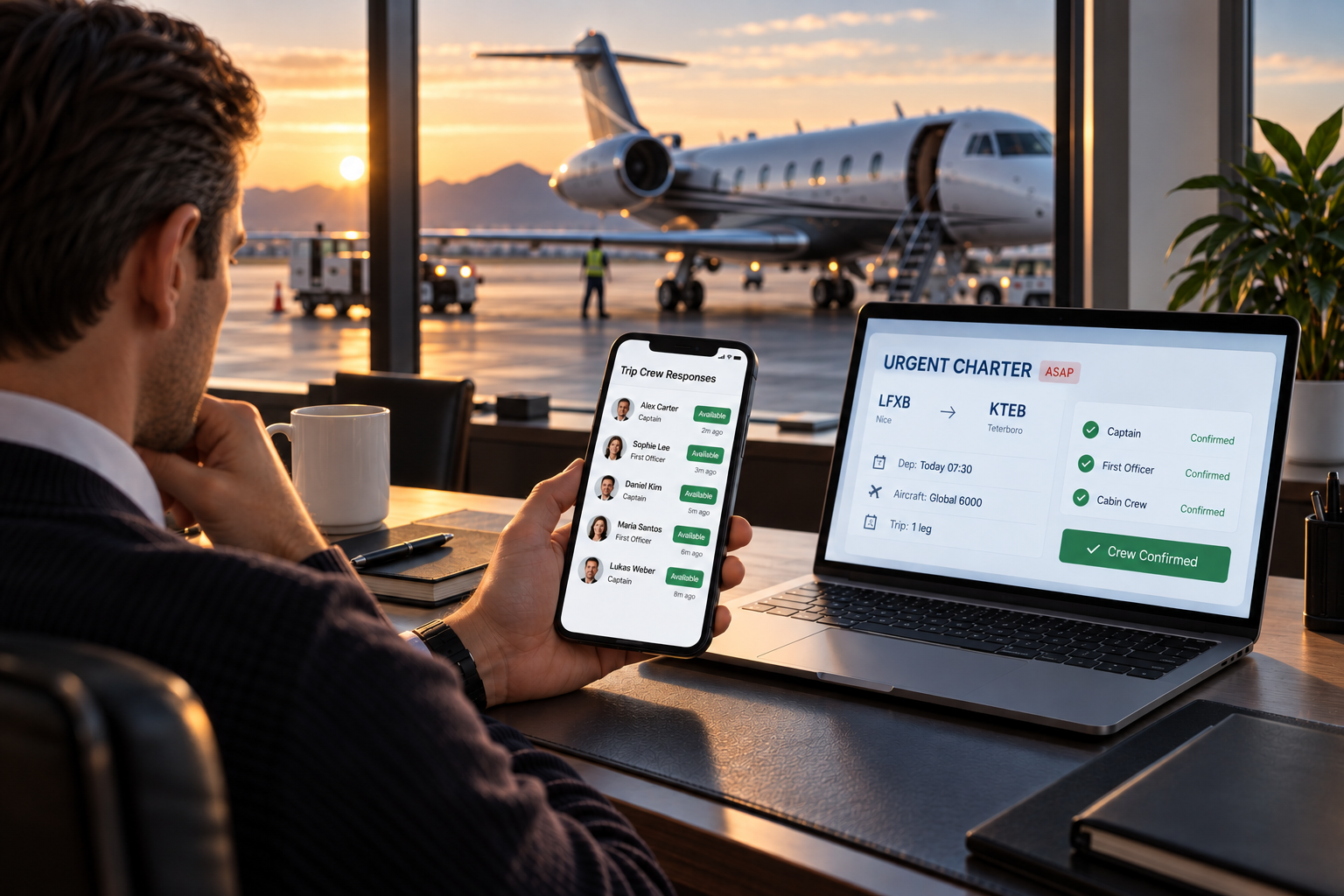
It's 5:47am. You have a charter departing at 9am and your captain just called in sick. You have a client in the terminal, an aircraft on the ramp, and a first officer already at the airport with no one to fly with.
This is the scenario every charter operator dreads — and most have lived through more than once. How you handle it depends almost entirely on the system you've built before it happens.
Why last-minute trips expose everything wrong with your crew process
Last-minute crew changes are a stress test for your operations. They expose:
- Whether your pilot contact information is current and accessible
- Whether your bench pilots are actually reachable on short notice
- Whether you know which pilots are rated on the required aircraft
- Whether your team can coordinate quickly without creating compliance gaps
If any of those fail under pressure, you either delay the flight — which costs you a client relationship — or you scramble and make decisions you can't fully document, which costs you compliance coverage.
The phone-call approach and why it breaks down
Most operators still fill last-minute trips by calling down a mental list. Call the most reliable captain first, leave a voicemail if no answer, try the next one, loop back, wait, try again.
This process has three problems:
- It's sequential. You contact one pilot at a time, which means your total fill time is the sum of every individual response wait. In a 90-minute window, you might only reach 3–4 pilots before you're out of time.
- It creates no record. Who did you call? In what order? At what time? If someone later asks — and in aviation, someone always eventually asks — you have no defensible answer.
- It depends on one person. The knowledge of who to call and in what order lives in your ops manager's head. When they're not available, the system fails.
What the fastest-filling operators do differently
Operators who consistently fill last-minute trips in under 30 minutes share a few common practices:
They notify multiple pilots simultaneously
Rather than calling one pilot at a time, they send a notification to all qualified, available pilots at once. This means the first available pilot can respond immediately — not after working through a sequential call list.
They make responding frictionless
A pilot who gets an SMS with a one-tap response link can confirm availability in 10 seconds, regardless of where they are or what they're doing. A pilot who has to call back, log in to a portal, or reply to an email chain takes much longer — and may not bother if they're inconvenient to reach.
They pre-filter by qualification
They don't waste time notifying pilots who aren't rated on the aircraft or can't legally take the trip. Before the notification goes out, the system filters for type rating, role, and availability. Only qualified pilots get the message.
They have a live view of responses
While notifications are going out, someone on the ops team is watching a live dashboard: who's been notified, who's responded, what their status is. As soon as the first available pilot responds, the assignment can be confirmed immediately — not after chasing them for confirmation.
Build the system before you need it
The operators who handle last-minute trips best aren't better at crisis management — they've just built a system that makes the crisis routine.
That system has three components:
- A maintained bench. Pilot contacts, ratings, and home bases are current, accessible, and searchable — not buried in someone's phone or a shared spreadsheet that's three months out of date.
- Instant multi-pilot notification. When a trip needs filling, one action sends an SMS and email to every qualified pilot simultaneously. No manual dialing, no voicemails, no waiting.
- A real-time response view. The ops team can see availability coming in without following up manually. The first available pilot gets confirmed. The assignment is logged automatically.
"I had a client in the terminal at 9am and three pilots had responded Available before I finished my first coffee." — Charter Director of Operations, London
What about seniority?
If your operation requires offering trips in seniority order, last-minute trips are where that requirement is hardest to satisfy manually. Automated seniority queuing solves this: the system works down the list in order, waits the configured window for each pilot, and advances automatically when there's no response. Every step is timestamped.
For a last-minute trip with a 30-minute window per pilot, the system notifies pilot #1, waits 30 minutes, advances to pilot #2 if there's no response, and so on — all without someone manually tracking the clock and making calls.
The downstream benefit: fewer last-minute trips
When you have a well-managed bench and a fast notification process, you'll notice something unexpected: fewer trips feel truly last-minute. Because you can fill a crew in 20 minutes instead of 90, the threshold for what counts as a crisis shifts considerably.
A sick crew member at 6am is still an early start — but it stops being a crisis when you have a system that handles it in the time it takes to make a coffee.